
Homework
Homework is an important part of learning at Exmouth Community College. By completing it regularly, students revisit what they have learned, build their knowledge and confidence, and experience the success that comes from steady effort. We are working together to create a positive homework culture where students’ effort, progress and achievements are recognised.
Key Principles:
- Purpose: Homework helps to consolidate knowledge, develop critical thinking, and prepare for future learning. It encourages students to take responsibility for their education.
- Consistency: Homework expectations will gradually increase as students move through each year, supporting the development of independent learning skills.
- Support: Teachers will provide clear instructions and offer guidance, especially in the earlier years, to help students build effective study habits.
Year 7-9: Laying the Foundation
- Homework will focus on reinforcing concepts learnt in class, building foundational skills, and promoting time management.
- Tasks will be structured, with clear instructions and regular feedback to support students in becoming more independent.
- Students will be encouraged to seek help from teachers and peers when needed, fostering a collaborative approach to learning.
Year 10-11: Encouraging Greater Responsibility
- Homework will require more independent thinking and problem-solving, with less teacher-directed guidance.
- Students will be expected to manage their time effectively, balancing homework with extracurricular activities and personal commitments.
- Teachers will encourage students to develop study routines and start to take ownership of their learning by setting their own goals.
Year 12-13: Promoting Full Independence
- Homework in Years 12 and 13 will primarily focus on preparing for exams, independent research, and deepening understanding of complex topics.
- Students will be expected to demonstrate strong time-management skills, with more autonomy in choosing how to approach tasks.
- At this stage, students should be able to set long-term academic goals and self-assess their progress, ensuring they are ready for further education or the workforce.
What students are expected to do:
Students in Years 7, 8 and 9 follow a weekly homework timetable. They should complete the task shown on the timetable for that day.
Students should expect to spend around 30 minutes on homework each evening. For retrieval practice, they use the Student Guidebook to review that week’s questions and answers, then use the Student Workbook to test themselves and record their answers. English, Maths and Science tasks use the relevant SPARX platform.
Homework Schedule
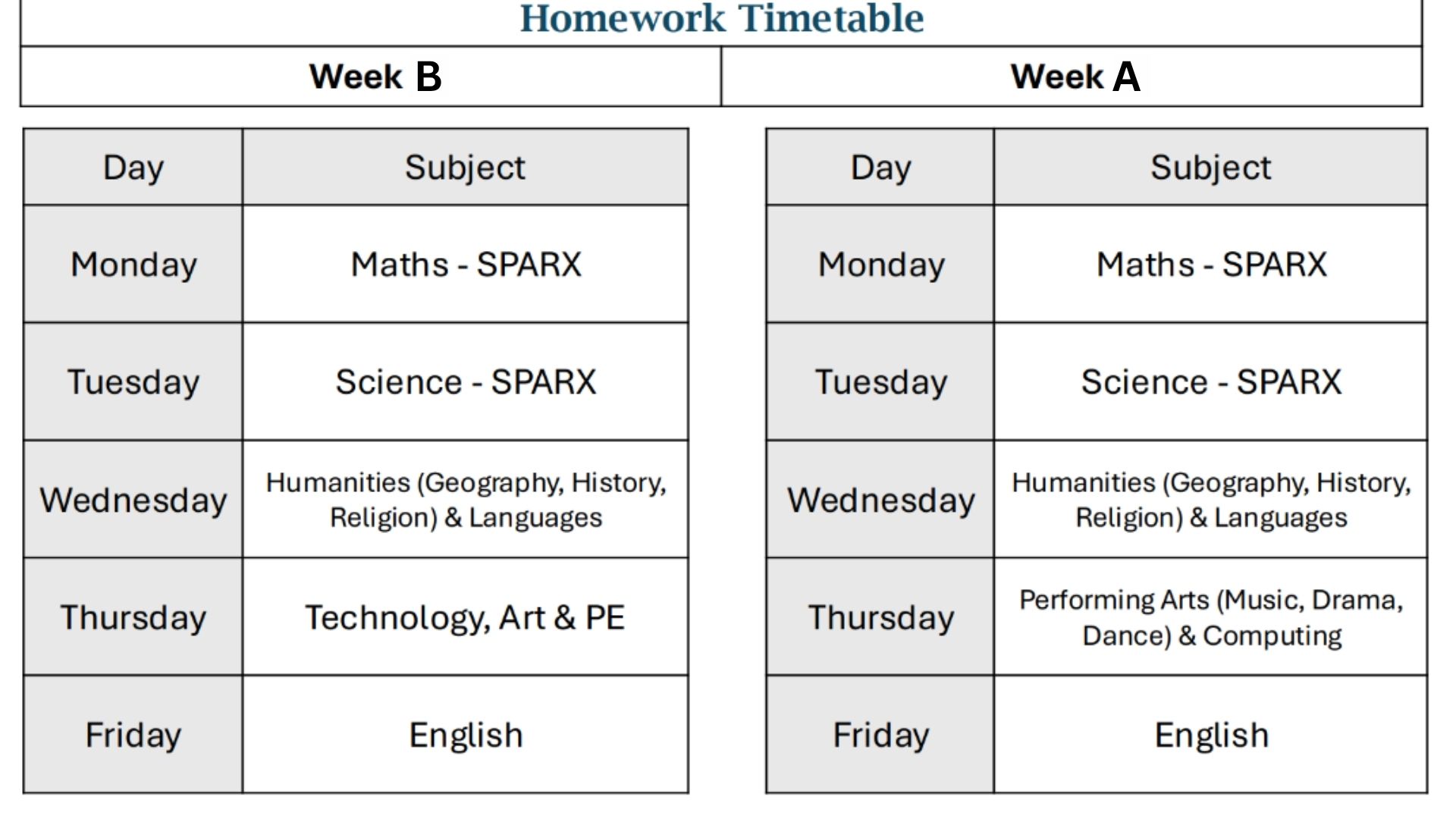
How to complete retrieval questions
Students should:
-
Read the week’s questions and answers in the Guidebook twice.
-
Practise recalling them, then write the questions in the Workbook.
-
Cover the Guidebook and answer the questions from memory.
-
Check and correct their answers in purple pen, including spelling, punctuation and grammar.
For SPARX Maths tasks, students should write the question code, show their working where relevant, check and correct their answers with a purple pen, and watch the question video if they are unsure on the question. For SPARX Science, students can just use the space provided to make any notes they wish to and to state how long they spent on the homework. Students should start early enough to ask their teacher for help or attend a homework support session.
Students studying French or Spanish complete only the language they study. Students on the Bridging Pathway do not need to complete the Languages section; their homework is set on Lexia through the Power Up app. They should work towards their target minutes and units, including tasks in Comprehension, Word Study and Grammar.
Support, effort and recognition
We want students to build confidence and positive study habits. For now, parents and carers may sign the Workbook to confirm 30 minutes of focused study, even if the student has not completed every question. Students with identified educational needs may use suitable adjustments, such as talking through their answers with someone at home. These adjustments can be noted in the Workbook so tutors can recognise the effort.
Tutors check homework completion. Students can earn ClassCharts praise points for every completed homework, with additional rewards for exceptional independent learning. Students who complete a five-day homework streak are also recognised by a notification sent to parents as well as entry into a prize draw.
Why homework matters
Retrieval questions give students regular practice in recalling what they have learned, helping them revisit subject knowledge over time. Checking answers helps students notice what they know and what they may need to practise further. A regular homework routine also gives students opportunities to practise working independently and to seek help when they need it.
Additional homework help sessions are also in place for students who seek additional help and students should ask their subject teacher as to when these take place.
Class Charts
All homework will continue to be set on Class Charts, for both student and parent/carers awareness. Completion of homework will be closely monitored by tutors during registration as part of the equipment check and teachers will monitor the completion and impact of homework upon students' work in lessons, quizzes, tests and in examinations. Staff will encourage students to invest their time and efforts in completing their homework in line with the rewards and sanctions policy.
Homework and Study Support
If a student would like to attend Homework and Study Support, please contact Sarah.Lasker@exmouthcollege.org
Please communicate with your child's subject teacher for subject-specific support or your child's tutor if there are more general concerns.